Where Do Babies Get Their Gut Bacteria From?
The human microbiome is a microbial community defined as the full of all microbes living in or on the human body. It affects the nutrition of the torso, its metabolism, and its immunological responses. Adaptive and innate immune factors influence the microbiome and dietary patterns, medication, and toxins. Human illnesses besides alter the microbiome profile.
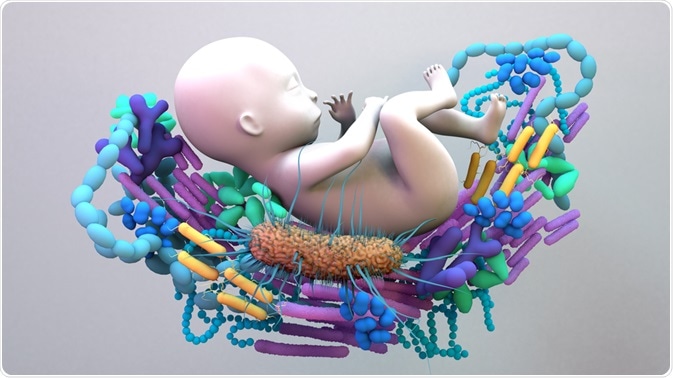
Prototype Credit: Design_Cells/Shutterstock.com
Gut microbiome in newborns
The gut microbiome is among the virtually important parts of the microbiome in humans. It begins to evolve during fetal life. The most important source of gut organisms is the mother's gut microbiota, to which the newborn is exposed. These leaner spread to the child'due south digestive tract, respiratory organs, urogenital tract, and the skin at or before the time of nascence.
Over ane week after nativity, babies have developed a gut microbiome containing Actinobacteria, Proteobacteria, Bacteroidetes, while Firmicutes are relatively low, though present. This indicates that babies are exposed to these leaner before birth, rather than after, from a source such equally the placenta.
The intrauterine surroundings was previously thought to be a sterile one. Still, more recently, research suggests that the aforementioned microbes are nowadays in the fetal meconium (stool) and the amniotic fluid, and the placenta besides contains microbes. In such a case, microbial colonization would occur long before delivery.
The microbes in the placenta comprise a wide spectrum, including Firmicutes, Tenericutes, Proteobacteria, Bacteroidetes, and Fusobacteria phyla. These are besides plant in the mouth.
Vaginal vs. cesarean delivery
After a vaginal delivery, infant gut microbiomes are typically colonized by maternal vaginal flora like Lactobacillus and Prevotella species. In dissimilarity, maternal pare flora are ascendant after a cesarean delivery - Clostridium, Staphylococcus, Propionibacterium, and Corynebacterium. The number of anaerobic species, such as Bacteroides and Bifidobacterium, is low in babies worn via cesarean than those born vaginally.
This difference persists upwardly to seven years after birth, and the gut of Cesarean-born infants continues to accept an overall lower number of species. The differences betwixt individual neonates are due to the variability of immune-microbiota interaction. To compensate, the practice of vaginal seeding has been carried out, though it is now considered unnecessary and potentially unsafe.
Overall, the pattern of advent of aerobes such as Staphylococcus, Streptococcus, and Enterobacteria, with anaerobes such as Eubacteria and Clostridium appearing later, while Bacteroides emerge at dissimilar time points. The presence of Bifidobacteria is controversial, and more research is required to reverberate the neonatal gut's microbial contour accurately.
Researchers Emily Gritz and Vineet Bhandari say, "Gut colonization patterns established inside the first week of life are idea to accept effects on the limerick of the private's hereafter gut microbiota via a variety of factors."
Moreover, Cesarean birth is connected to a college risk of inflammatory bowel affliction, type 1 diabetes, coeliac affliction, childhood asthma, and obesity.
Breast milk and the newborn gut microbiome
Human milk contains many non-nutritional factors such equally lactoferrin, secretory immunoglobulin A (sIgA), oligosaccharides, interleukin-ten, and other inflammatory mediators, which may play key roles in the inflammatory response to bacteria in the gut.
Breast milk also contains living bacteria belonging to Staphylococcus, Streptococcus, Bifidobacterium, and Lactobacillus. Some of these accomplish the milk via the entero-mammary pathway. Bifidobacterium and Bacteroides, which are probiotic, thrive on undigestible carbohydrates in milk, which ferment in the colon.
Nonetheless, breast milk becomes more compatible in composition, shifting from microbes present on the peel and gut, institute in colostrum, to those found on babe skin and mouth in mature milk. Microbes from the mother's breast skin and intestine have traveled via the intestinal lymphoid cells to the chest.
Formula-fed infants will have a different microbial pattern because the oligosaccharides in formula milk take a dissimilar structure from those in breast milk. Like adults, their gut microbiome is dominated by Clostridia. Unlike the dominance of Bifidobacterium and Lactobacillus in exclusively breast-fed infants, the old group has greater bacterial diversity, even if only a pocket-sized fraction of feeds are made up of formula.
Bifidobacterium species are virtually unremarkably involved in normal development. The abnormal contour in formula-fed infants can be corrected by providing a why-based formula rather than the conventional blazon.
Secretory IgA reflects the female parent's microbiota and protects both the baby's gut and immune arrangement against infection past pathogens that could cause an unhealthy microbiome. It binds microbial antigens and triggers a "tolerogenic" mode of innate immune responses when exposed to such antigens, regulating immunity via multiple pathways. This modulates the function of the gut microbiome.
A healthy gut microbiome has numerous benefits, including a lower gamble of obesity, digestion of indigestible sugars, and lipoprotein lipase activation to promote fatty acid deposition in storage tissue. Glucose is also absorbed more rapidly.
The gut microbiome provides microbial signals that activate innate immune cells just induce regulatory T cells and sIgA, thus preventing the overactivation of helper T cells. Lack of such exposure is thought to be partly responsible for asthma, allergies, and diabetes, due to autoimmune activity.
Preterm vs. term babies
Infants built-in with a weight below i,200 g seem to take mostly Firmicutes and Tenericutes species in the gut. This shows that the extent of seeding of the microbiome depends on the term of pregnancy, probably considering swallowing begins with neurological maturation during the third trimester.
Preterm babies are at increased run a risk of gut dysbiosis. The factors responsible include antibiotic exposure, increased gamble of Cesarean section or rapid vaginal delivery, formula feeding, prenatal illness or medications in the female parent, potential maternal infections, smoking, stress, and resulting inflammation. Post-natally, too, these infants are at college risk of invasive procedures, pathogenic flora in the neonatal intensive intendance unit, medications that alter their gut pH, and lack of exposure to the microbiota of the mother and the home.
Preterm infants too bear witness reduced microbial diversity and increased proliferating pathogens, too existence less stable and showing a delay in conversion to the adult pattern.
Antibiotics and the newborn microbiome
Infants born to mothers who receive antepartum antibiotic prophylaxis prove a significantly unlike microbial profile, such as the overall reduced diversity of the gut microbial customs. The levels of Actinobacteria, Bacteroidetes, Bifidobacterium, and Lactobacillus are reduced, while those of Proteobacteria, Firmicutes, and Enterococcus increase.
Similar effects occur if the infant is given antibiotics. In preterm infants, this loss of variety is associated with a college hazard of necrotizing enterocolitis (NEC), which has a high mortality rate in this grouping.
Newborn pare microbiome
The newborn peel is susceptible to various ecology influences that cause irritation, immune reactions, and actual cuts and abrasions. Different the intrauterine milieu, the newborn baby's skin has to adapt to changes in the pH, loss of water through the skin, and growth of the stratum corneum.
Early pare colonization is of import in producing a healthy pare acid mantle and protecting the developing immune organization. The vernix caseosa is an of import correspondent to skin health past keeping the pare hydrated, reducing the pH, and preventing pathogenic infections. This fatty-protein-antimicrobial layer present at birth should therefore exist allowed to remain except at skin folds. The baby is cleansed with h2o merely rather than with soap and water.
More research will help understand how the newborn develops a microbiome protective confronting many futurity disease states, including the variables that touch on it other than feeding patterns, mode of delivery, and antibody exposure. This will assistance develop suitable interventions, especially for women and their newborns, during the first 1,000 days of life, the critical window of microbial exposure.
Developing a infant'south microbiome
References
- Gritz, East. et al. (2015). The Human Neonatal Gut Microbiome: A Brief Review. Frontiers in Pediatrics. https://doi.org/10.3389/fped.2015.00017. https://www.frontiersin.org/articles/10.3389/fped.2015.00017/total
- Yan Shao et al. (2019) Stunted Gut Microbiota and Increased Pathogen Colonization Associated with Caesarean Birth. Nature. DOI: ten.1038/s41586-019-1560-1
- Stinson 50. F. et al. (2018). A Critical Review of the Bacterial Baptism Hypothesis and the Impact of Cesarean Commitment on the Baby Microbiome. Frontiers in Medicine. DOI: 10.3389/fmed.2018.00135
- Mutic, A. D. et al. (2018). The Postpartum Maternal and Newborn Microbiomes. MCN The American Periodical of Maternal and Child Nursing. https://dx.doi.org/10.1097%2FNMC.0000000000000374.
- Moore, R. et al. (2019). Temporal development of the infant gut microbiome. Open Biology. https://doi.org/10.1098/rsob.190128
- Yang, I. et al. (2016). The Infant Microbiome: Implications for Baby Wellness and Neurocognitive Development. Nursing Research. https://dx.doi.org/10.1097%2FNNR.0000000000000133
- Turroni, F. et al. (2020). The Infant Gut Microbiome equally A Microbial Organ Influencing Host Well-Beingness. Italian Periodical of Pediatrics. https://doi.org/x.1186/s13052-020-0781-0
Farther Reading
- All Microbiome Content
- The Human Microbiome Project (HMP)
- How Does the Diet Impact Microbiota?
- Achievements of the Homo Microbiome Project
- Human being Microbiome
Source: https://www.news-medical.net/health/The-microbiome-of-a-newborn.aspx
0 Response to "Where Do Babies Get Their Gut Bacteria From?"
Post a Comment